
Solar sector can drive India’s energy independence : Experts
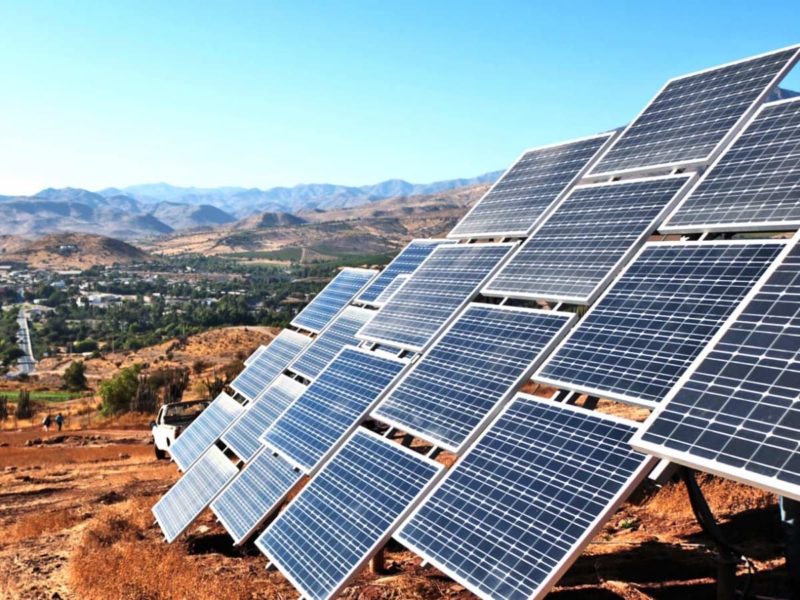
Power companies renewable energy commitments make up 67% of 450GW by 2030 target
Solar sector can drive India’s energy independence, needs financial and technological push, says experts

New Delhi : With less than 60 days to COP26 (United Nations Climate Change Conference), countries around the world are gearing up to be more ambitious on their climate pledges. India may not commit to the net zero emissio timeline of mid-century but it is expected to enhance the target of climate action.

India’s Paris agreement target of 40% installed capacity from non-fossils has already been met. India now has an even more ambitious target of 450GW of renewable energy by 2030. Of this target, Indian power companies have already committed to build 67% (301GW) of the target by 2030.
At a webinar organised Yesterday by Climate Trends, experts from Solar sector, Institute for Energy Economics and Financial Analysis (IEEFA), and EMBER discussed the challenges and opportunities ahead for India to meet its 450 GW target by 2030.
With the IPCC report flagging the urgency to act on mitigation, the focus on energy transition has become a matter of priority. India has taken a leadership position in raising its ambition to achieve 450 GW by 2030, which means 39 GW of renewable capacity addition every year to meet this target. However post Covid-19 the growth in the sector has slowed & is facing challenges- financial, manufacturing & demand.
Another area of concern remains is India’s continued reliance on coal for energy generation, which will
destabilize its climate commitment. A recent EMBER & Climate Risk Horizons report flagged that 27 GW of “unnecessary” pre-permit & permitted new coal plants could jeopardise India s renewable energy ambition. These coal power plants will require Rs 247,421 crore ($33 billion) of investment and due to surplus energy generation capacity will remain idle or function uneconomically.
Aditya Lolla, Senior Electricity Analyst, Ember
India should not be too afraid of thinking beyond coal now. Battery storage and demand side management measures have a crucial role to play in India s clean power transition journey”
Experts unanimously supported that battery storage will play a crucial role in tackling the peak power demand. According to the CEA report on using coal for the peak power demand, the cost of energy will be around 6 to 7 rs kilowatt/ hour as the plant will operate only on 20 to 25 % plant load factor, hence energy storage will play a critical role.
Mr Santosh Khatelsal, Founder, Enerparc India said, “On storage there are companies setting up manufacturing units with automotive batteries as an end goal. The automotive batteries will lead the storage and the power side will piggyback on the automotive battery storage, so we are looking at batteries for automotive as well as for energy storages. From a technology perspective, Lithium is the winner right now in terms of energy density. However China is already dominating and ‘Lithium deposits’ is again going to be a war. As an alternative Zinc A is another promising option and would be coming fairly soon in commercial use. ‘Flow batteries’ is another technology and seems to be commercially viable.”
Experts see Hydrogen as the next viable option after battery but it would take 5-7 years for Hydrogen for commercial use. “Storage is not only a battery, there is another side of hydrogen. Hydrogen can handle bthe heat side as well and that is the gaining point. Storage will grow in multiple forms instead of one. The end product cannot be just hydrogen, it needs to become ammonia, methanol, etc. as it is the deadliest substance and we cannot handle it in terms of transport or compressing it. Batteries are advanced and hydrogen is lacking. It would take 6-7 years before hydrogen is made commercially viable. It is in an early adoption phase and will take time to move to mass adoption phase,” added Santosh Khatelsal.
Talking about the market intervention and efficacy of ESG, Sandeep Hasurkar, Former Head of Project Finance,IL & FS Renewables & Author- Never too Big to Fail said that Environmental, Social and Governance (ESG), is not a key driver as the government is more driven by economic objectives with few other parameters. There is strong movement for ESG to be seen as imperative. There are three aspects – Technology, Market and Finance. ESG concerns have risen as a huge amount of funds are now coming in for the projects partly due to future planning. Finance moves in a way where technologies and markets are going to be in the future and in this case Solar is the future.
On Big Energy Players like Reliance making their segway into clean energy, he said that “Reliance is only moving into solar when it knows that there is an alternative to DISCOMS and contracts. The dependency of investment no longer depends on traditional electricity sectors and lots of options are coming up. This is probably the right time to invest into solaIr. Also Reliance are eying hydrogen now and it indicates that it's time to reassess the market and see where it is heading. Hydrogen is on the cusp of commercialisation. So we need to know how much money we can put on it and bring it at par by bringing it down in terms of cost and scale.”
Speaking on similar lines, Rakesh Jain, Vice President,(New Business), Mytrah Energy, “With Reliance foraying into solar sector, it will only be beneficial for the country as it is a trusted name. Hydrogen should come, it is the interest of the country. Government should not venture into the business of manufacturing Hydro and can incentivise through policy regulations. India needs technological innovation, only then it will have sustainable planning. Government has to promote alternative technology and R & D capacity.”
Experts feel that though DISCOMS are the heavyweights but they are also the weakest link in the chain, which is actually holding back the growth. “Weakest links in the chain are the DISCOMS. These have made a mess irrespective whether it is coal or renewable based energy. Big promises were made but discoms have failed to adhere to their commitments in terms of payment, power curtailment etc The recovery period of renewable energy projects are essentially mapped out by 20-25 years. Entire structure is based on contracts and how strong is the contractual framework is the question. It has never been streamlined.
Government will always find a way out but it is in the interest of the country that we should start looking for alternative options like Hydrogen to overcome these problems,” said Mr Hasurkar. Rakesh Jain further added, “Everything will be doomed if DISCOMS are not able to improve their financials. Let the current BJP led state governments make big privatisation plans to actually prove their interest and concern for the sector. In the power sector, we must also look for democratization of the solar-power sector so as to move from B2G to B2C or B2B. This will minimise the role of DISCOMS. In this sector, only big participants are there. Everybody needs to participate in this journey, which at present is not happening. Hence, democratization is the need for India’s progress in the solar sector. There has to be an economics of alternative i.e. lesser reliance on government. DISCOMS are the big daddies and we cannot ignore them but also cannot deny that DISCOMS economies are completely messed up.”


